
Use compound interest calculator to easily calculate compound interest on total principal amount over a fixed period of time.
Total Investment
Rate of Interest (p.a.)
Time Period
Period Type
Compounding Frequency
Total amount payable over a selected period of time
0
Total Investment
0
Total Interest
0
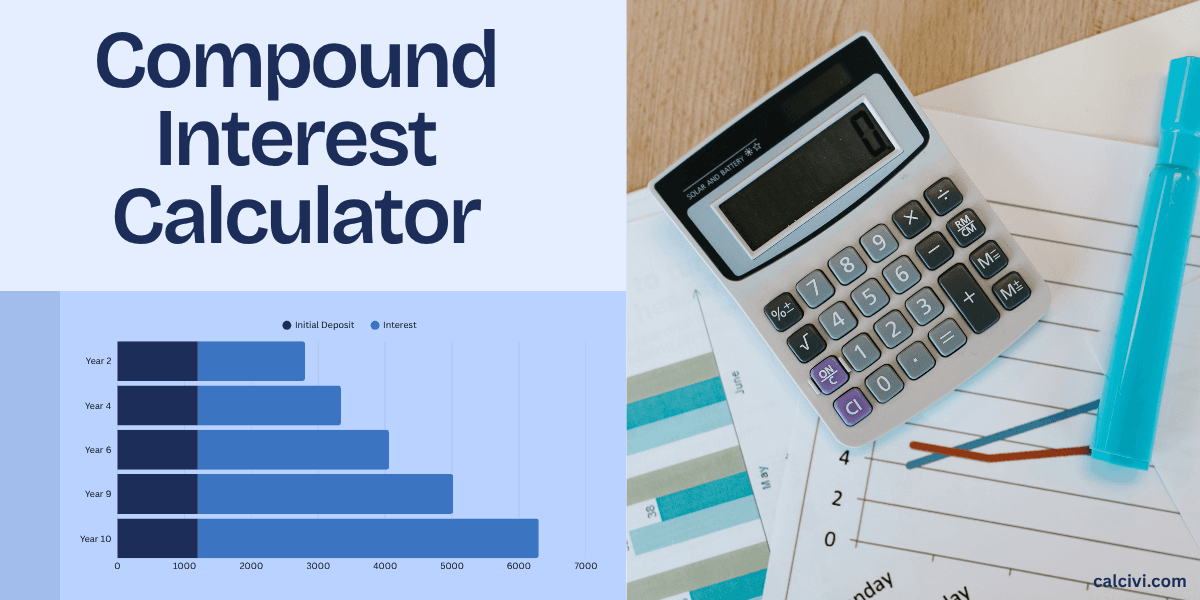
Ready to visualize how your money can work for you? Compound interest is often called the “eighth wonder of the world,” and for good reason. Unlike simple interest, which is calculated only on your initial deposit, compound interest allows you to earn interest on your principal plus all the interest that has previously accumulated.
Compound Interest Calculator is a powerful, minimalist tool designed to help you project the future value (FV) of your investments, demonstrating the true impact of time and consistency on wealth building.
How Compound Interest Works: The Snowball Effect
The easiest way to understand compounding is the “snowball effect.”
Imagine rolling a small snowball down a snow-covered hill. At first, it gathers very little snow. But as it rolls, the surface area increases, and it picks up more snow faster. By the time it reaches the bottom, it’s massive.
In finance, your initial principal is the snowball. Reinvested earnings are the snow it picks up. Time is the length of the hill. The longer you let it roll, the faster it grows.
How to Use Calcivi Compound Interest Calculator?
Designed for a seamless Fintech experience, our calculator requires just a few key inputs to provide a precise projection:
- Initial Investment (Principal): The starting amount of money you are investing or saving.
- Regular Contribution (Optional): Are you adding more money weekly, monthly, or annually? Consistent additions drastically amplify compounding.
- Annual Interest Rate: The estimated percentage return you expect to earn per year.
- Time Period (Tenure): How long you plan to let the money grow (in years or months).
- Compounding Frequency: How often the interest is calculated and added back to the principal.
The calculator instantly generates your Total Saved, Total Interest Earned, and the Final Maturity Value, accompanied by a visual chart showing the curve of your exponential growth.
Simple vs. Compound Interest: Why Compounding Wins?
Understanding the distinction is vital for long-term financial planning.
| Feature | Simple Interest | Compound Interest |
| Calculation Base | Calculated only on the original principal. | Calculated on the principal plus accumulated interest. |
| Growth Pattern | Linear (straight line). It grows by the same amount each period. | Exponential (curved line). Growth accelerates over time. |
| Common Uses | Car loans, short-term personal loans, some certificates of deposit. | Savings accounts, stock market investments, retirement funds. |
| Long-Term Impact | Lower total returns for savers; lower total cost for borrowers. | Significantly higher total returns for savers; can be very costly for borrowers (e.g., credit cards). |
The Compounding Frequency Factor
The more frequently interest is compounded, the higher your final balance will be. For example, interest that compounds daily will generate a slightly higher annual percentage yield (APY) than interest compounding annually at the same nominal rate.
Our calculator lets you compare the effects of compounding daily, monthly, quarterly, semi-annually, and annually.
The Compound Interest Formula
While our calculator does the heavy lifting, authoritative financial planning requires understanding the math. The standard formula for compound interest is:
CI = principal * (1 + r)^n
Where:
- CI: The Future Value (FV) of the investment/loan, including interest.
- P: The Initial Principal amount (the starting investment).
- r: The annual interest rate (decimal).
- n: The number of times interest compounds per year.
- t: The time the money is invested for (in years).
Topical Insights for Wealth Building
The Importance of Starting Early
Time is the most crucial variable in the compounding equation. A person who starts investing at age 25 and stops at 35 will often have more money at retirement than someone who starts at 35 and invests consistently until age 65. The extra ten years of compounding are nearly impossible to make up.
The Rule of 72
A quick shortcut to understand compounding is the “Rule of 72.” To estimate how many years it will take to double your investment, divide 72 by your expected annual rate of return.
(Example: At a 6% interest rate, your money will double in approximately 12 years ($72 / 6 = $12).)
Compound Interest FAQ
Simple interest is calculated only on the initial amount of money you invest or borrow (the principal). Compound interest is calculated on that principal plus all the interest that has already accumulated from previous periods. Essentially, simple interest is a straight line, while compound interest offers “interest on interest” that snowballs over time.
The more frequently interest is compounded, the higher your final balance will be. For example, interest that compounds daily will result in a slightly higher final amount than interest that compounds monthly or annually at the same nominal rate. This is because your earnings are added back to the principal balance faster, allowing those new earnings to start generating their own interest immediately.
Time is considered the most important factor because compound interest is backward-loaded. In the early years of an investment, the growth seems slow and linear, similar to simple interest. However, as the accumulated interest base gets larger, the curve steepens dramatically. Starting early gives your money more time to snowball.
Compound interest is the standard for most growth-focused financial products where you want your money to increase over the long term. This includes basic savings accounts, High-Yield Savings Accounts (HYSAs), Certificates of Deposit (CDs), and retirement accounts like 401(k)s and IRAs.
Yes. While the basic compound interest formula calculates growth on a one-time lump sum, the Calcivi Compound Interest Calculator includes a field for Regular Contributions. By entering an amount you plan to save weekly, monthly, or annually, you can get a precise projection of how your investment maximize your total wealth.
Calcivi: Minimalist Tools for Global Wealth
Our mission at calcivi is to provide precise, clutter-free tools that empower your financial journey. Our compound interest calculator avoids unnecessary distractions, focusing entirely on providing the accurate data you need for informed retirement planning or wealth management.