
FD Calculator: Accurate Fixed Deposit Maturity & Interest Estimator
Total Investment
Rate of Interest (p.a.)
Time Period (In years)
Total value of your FD over selected period will be
0
Total Investment
0
Total Interest
0
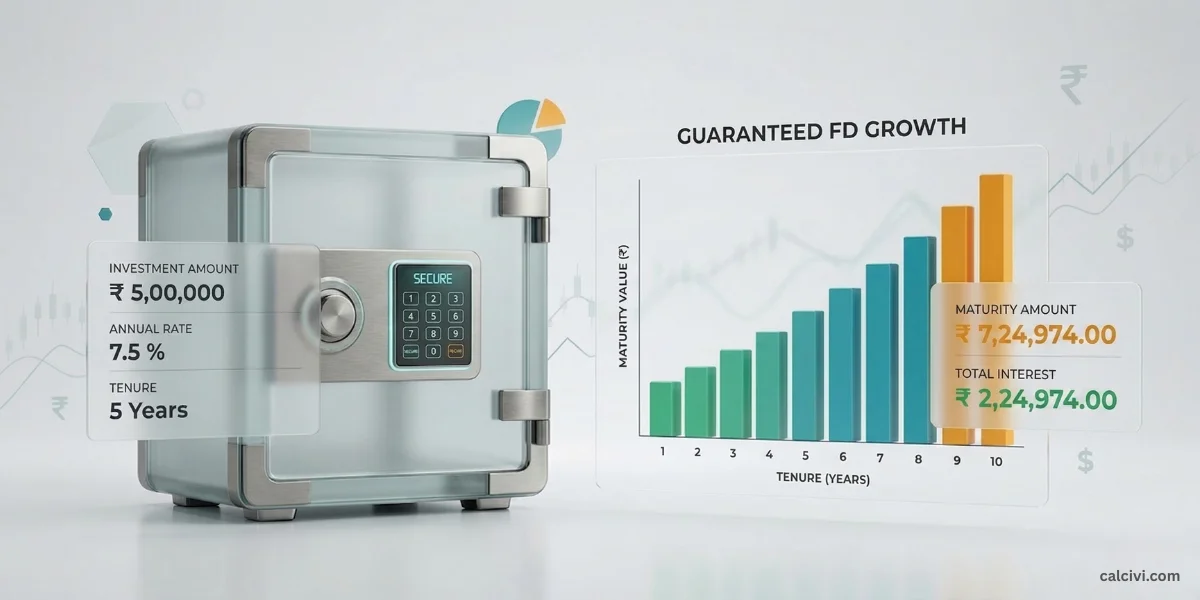
When it comes to securing your financial future, certainty is a luxury. A Fixed Deposit (FD) remains one of the most trusted investment vehicles because it offers guaranteed returns, regardless of market volatility.
FD Calculator is a precision tool designed for the modern investor. Whether you’re planning for a short-term goal or long-term wealth preservation, this tool helps you visualize exactly how much your money will grow before you commit a single penny to the bank.
How to Use the Calcivi FD Calculator
We believe financial tools should be intuitive and clutter-free. To estimate your returns, simply input:
- Investment Amount (Principal): The total lump sum you wish to deposit.
- Annual Interest Rate: The percentage offered by your bank or financial institution.
- Tenure: The duration of the deposit in years, months, or days.
The calculator will instantly reveal your Total Interest Earned and the Final Maturity Value.
What is The FD Interest Formula
Most banks use compound interest to calculate FD returns. The frequency of compounding, whether monthly, quarterly, or annually can significantly impact your final “take-home” amount.
The standard formula used by our calculator is:
I = principal * (1 + r)^n
Where:
- I: The Interest earned amount
- P: The Principal (your initial deposit).
- r: The annual interest rate (as a decimal).
- n: The total tenure in years.
Why Choose a Fixed Deposit in 2026?
In an era of shifting market trends, war times and volatile markets, FDs provide a “safe harbor” for your capital.
- Capital Protection: Unlike equity-linked investments (SIPs), your principal is not at risk.
- Senior Citizen Benefits: Most institutions offer an additional 0.50% to 0.75% interest rate for individuals over 60.
- Tax Saving (Section 80C): 5-year “Tax-Saver” FDs allow you to claim deductions on your taxable income (up to ₹1.5 lakh under the old regime).
- Liquidity: While FDs have a fixed term, most allow for premature withdrawal or a “loan against FD” in case of emergencies.
Fixed Deposit Vs. Recurring Deposit
Understanding the difference between fixed deposit and recurring deposit, is key to a smart strategy:
- Fixed Deposit (FD): Best if you have a lump sum of cash ready to invest. You deposit it all at once and earn interest on the full amount from day one.
- Recurring Deposit (RD): Best for salaried individuals who want to save a small portion of their income every month.
Understanding Taxes on Your Interest
It’s important to calculate your net returns. As of the 2025-26 financial year, banks are required to deduct TDS (Tax Deducted at Source) if your annual interest exceeds:
- ₹50,000 for regular individuals up to 60 years of age.
- ₹1,00,000 for senior citizens above 60 years of age.
In India, If your total income is below the taxable limit, you can prevent this deduction by submitting new revised Form 121 to your bank.
FD Calculator – FAQ
Yes. Since senior citizens usually receive a higher interest rate, simply input the specific “Senior Citizen Rate” (often 0.5% higher than standard rates) into the interest field of FD calculator, to see the adjusted maturity value.
Absolutely. The more frequently interest is compounded (e.g., quarterly vs. annually), the higher your effective yield will be. Most banks compound quarterly, which means your interest starts earning its own interest four times a year.
Our calculator provides a highly accurate estimate based on the mathematical formula. However, the final amount credited to your account may vary slightly due to TDS (Tax Deducted at Source) if your interest income exceeds the government’s tax-free thresholds.
If you opt for a premature withdrawal, banks typically charge a penalty (usually 0.5% to 1%) on the applicable interest rate. This means your final maturity value will be lower than what is shown on a standard calculator.
It depends on your goal. FDs offer guaranteed risk-free returns, making them ideal for short-term goals or emergency funds. SIPs (Mutual Funds) offer the potential for much higher returns but come with market risk. Many investors use both to balance stability and growth.